Professional Furnace Installation Services in Kansas City
Don’t face another cold Kansas City winter with a furnace that can’t keep up. It’s not just going to make your home comfortable; it makes great financial sense! One of the best investments you can make in your home is to replace an old or broken heating system. There are many benefits to having a new, energy-efficient heater working in your home.
New Heating Installation
Steve’s Heating & Cooling is the Northland’s team of heating system installation experts. We are professional installers of furnaces and other heating systems for homes and businesses across our community. We are Kansas City’s certified Custom Care Dealer of quality American Standard heating and cooling products – depend on made-in-America comfort systems!
What You Need to Know About Furnace Installation in Kansas City
Steve’s Heating & Cooling has been installing furnaces in Kansas City since 1979. That’s a lot of basements. A lot of crawl spaces. A lot of conversations with homeowners trying to figure out if they really need a new furnace or if their neighbor’s brother-in-law who “knows HVAC” is right about just needing a repair.
Here’s the straight answer: if you’re asking the question, you probably need to have someone look at it. But do you need a new furnace? That depends on more than age alone. Let’s walk through how we actually make that call.
When Your Furnace Is Actually Done
Age matters, but it’s not everything. Yes, furnaces typically last 15 to 20 years. Some make it to 25 if you’ve been good about furnace maintenance and haven’t had any major problems. But I’ve seen 12-year-old furnaces that are toast and 22-year-old units still chugging along fine.
What kills furnaces around Kansas City isn’t just time. It’s the workload. Our temperature swings are brutal on equipment. Last winter we had days where it didn’t get above 10 degrees. Your furnace ran almost nonstop for three or four days straight. Then, a week later, it was 58 and sunny, and the furnace barely ran. That constant cycling—extreme use followed by barely any use followed by extreme use again—that’s what wears equipment out faster here than in places with more predictable weather.
Repair costs start telling you when it’s time. If you’re looking at a $1,500 repair on a 15-year-old furnace, we’re having a serious conversation about whether that money’s better spent on a new unit. Not because we want to sell you a furnace—we’ll fix it if that’s what makes sense—but because that $1,500 might just buy you another year or two before something else breaks. And then you’re out another $1,000. At some point you’re just throwing good money after bad.
Efficiency matters way more than people realize. If you’ve got a furnace from the ’90s or early 2000s, it’s probably 70% to 75% efficient at best. New furnaces are running 95% to 98% efficient. That’s a massive difference when you’re heating a Kansas City house through winter. We’re talking hundreds of dollars a year in savings. Over the life of the furnace, that efficiency difference can pay for a good chunk of the installation cost.
Carbon monoxide concerns should also be part of the conversation. If your heat exchanger’s cracked, we’re not repairing it. We’re replacing the furnace. Period. I don’t care if it’s only 10 years old. A cracked heat exchanger means carbon monoxide can leak into your house, and that’ll kill you. Not being dramatic but it actually will. When we tell you the heat exchanger’s cracked, that’s not us trying to sell you something. That’s us telling you the furnace is unsafe to operate.
Sizing Actually Matters (Stop Going Bigger)
What’s the biggest mistake homeowners make? Thinking bigger is better. “My old furnace was 80,000 BTU and couldn’t keep up, so put in a 100,000 BTU unit.” No. That’s not how this works.
An oversized furnace is worse than an undersized one. Seriously. When your furnace is too big for your house, it heats the space too quickly, shuts off, cools down, fires back up, heats too quickly again, and shuts off. That’s called short cycling, and it’s terrible for the equipment. It wears everything out faster and wastes energy without you ever getting comfortable because it’s cycling on and off constantly instead of running long enough to even out the temperature.
We do a proper load calculation for every installation. This calculation takes into account your square footage, insulation, windows, how many exterior walls you have, ceiling height, and ductwork. The right-sized furnace for a 1,800 square foot house in Kansas City depends on a lot more than just those 1,800 square feet. A well-insulated newer house needs less heating capacity than a drafty 1920s home with original windows.
Kansas City houses are all over the map. We’ve got everything from brand new construction with modern insulation to century-old homes that were built before insulation was even a thing. The furnace that works perfectly in a new build in Liberty isn’t the same size that’s right for an older home in Riverside with original hardwood floors and single-pane windows.
Installation Quality Beats Brand Name Every Time
People obsess over furnace brands. “Should I get American Standard, or some other brand?” Honestly? They’re all fine. The major brands all make good equipment. What matters as much as the brand name stamped on the side is the quality of the installation.
A top-of-the-line furnace installed wrong will cause you nothing but problems. An entry-level system installed right will run for 20 years without major issues. The installation is everything.
Ductwork matters. If your existing ducts are undersized, leaky, or poorly designed, the best furnace in the world won’t perform right. Sometimes a furnace installation means we’re also fixing or replacing ductwork. Yeah, that costs more. But what’s the point of spending $12,000 on a new 96% efficient furnace if half the heat’s leaking out through gaps in your ductwork before it ever makes it to your living room?
We see this constantly—a homeowner got a new furnace installed cheap, and six months later they’re calling us because their house won’t stay warm. We go out and find out the installer didn’t balance the ductwork, didn’t seal connections properly, left the old thermostat instead of installing a new one, and didn’t check the pressure. Shortcuts everywhere. That cheap installation ends up costing more once you factor in callback visits and fixes.
The thermostat needs to be part of the conversation, too. If you’re putting in a new high-efficiency furnace, your old mechanical thermostat probably isn’t going to control it properly. We usually recommend at least a programmable thermostat, ideally a smart thermostat, to help you schedule and optimize efficiency. The furnace and thermostat need to work together.
The Installation Process (What Actually Happens)
The installation usually takes a day. Sometimes a day and a half if we’re doing significant ductwork modifications or if it’s a complicated install.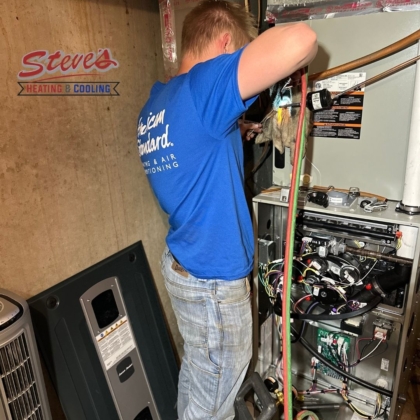
First, we pull out the old furnace. Disconnect the gas line (if there is one), disconnect the electrical, disconnect the ductwork, and out it comes. Depending on where your furnace is—basement, closet, attic, garage—this can be the easy part or the nightmare part. Basement installs in Kansas City are usually straightforward. Attic installs and a whole different story when you’re trying to maneuver a 150-pound furnace through a tiny attic access.
Then we prep the space. We make sure the gas line is sized right for the new furnace. Make sure the electrical circuit can handle the new furnace’s requirements. A lot of older homes only have a 60-amp or 100-amp service, and sometimes we’re pushing the limits of what that can handle. We check all that upfront before we ever schedule the install.
Then the new furnace goes in. We connect everything—gas, electrical, ductwork. We install the new thermostat. We install a new filter. We check the venting to make sure exhaust gases are venting properly. High-efficiency furnaces use PVC venting instead of metal flue pipes, so sometimes we’re running new vent pipes.
Then comes the testing. We fire up the furnace. We check the pressure. We check for any leaks. We measure the temperature rise across the heat exchanger. We make sure the blower’s moving enough air. We run it through several cycles to make sure it’s heating properly and cycling off when it should.
Before we leave, we walk you through the new system. We show you where the filter goes and how to change it and how the thermostat works. We explain what sounds are normal and what sounds mean you should call us. We gve you all the warranty information and answer whatever questions you have.
What Furnace Installation Actually Costs Around Here
Furnace installation in Kansas City metro—talking full replacement, not just swapping like for like—usually runs about $14,000. If you want only the furnace, be prepared to spend $3,800 to $4,000.
There are a lot of variables: the size of your house, whether we’re replacing ductwork. Do you need to upgrade your electrical? What efficiency level are you going with? A basic 80% efficient furnace costs less than a 96% two-stage variable-speed unit.
Financing helps. Most people don’t have thousands of dollars sitting around in an account. We work with financing companies that offer payment plans. Sometimes there are rebates or tax credits for high-efficiency equipment that help offset the cost.
Compare that to continuing to pour money into an old furnace that’s on its last legs while paying 40% more every month to heat your house because it’s so inefficient. The new furnace pays for itself over time through lower gas bills and not having to call for repairs every winter.
Why We’re Still Installing Kansas City Furnaces After All These Years
We keep doing this because we’re good at it, we like the people we work with, and Kansas City winters require furnaces that work.
We’re honest about what you need. If your furnace can be repaired and will give you another five years, we’ll tell you that instead of pushing a replacement. But if it’s past repairing, we’ll tell you that too. Our techs are not making commission on equipment sales. We’re building relationships with customers we’ll probably see again and again until their system needs replacing again.
Local matters. We’re here. We’ve been here since ’79. We’re not going anywhere. When you call us in three years because you think something’s wrong with your furnace, we’ll be the ones who show up. We stand behind our installations because we’re going to see you again.
We know Kansas City houses. We know what problems crop up in older homes in Riverside, Parkville and North Kansas City. We know what the new construction in the suburbs needs and which furnace brands hold up better in our climate. That knowledge comes from installing thousands of furnaces in this area over four decades.
Get It Done Before You’re Freezing
If you’re reading this in October and your furnace is 18 years old and making weird noises, don’t wait until January to call us. Get it looked at now. Get it replaced now if that’s what it needs. Because when it’s 12 degrees, and your furnace goes out, you’ve got limited options. Emergency install? Yeah, we can do it, but you’re paying emergency rates, and you’re probably not getting the exact furnace model you want because we’re installing what we’ve got in stock.
Plan ahead. Get a quote in the fall and get the installation done before heating season hits hard. Then you’re all set when winter actually arrives.
Call us at (816) 436-8475. We’ll come look at your furnace, talk through your options, and give you an honest assessment of whether you need to replace it now or if you can get another year or two out of it. That’s what we do. And if someone else gave you a quote and it doesn’t seems too high or not necessary, we are happy to give you a second opinion. That’s what we’ve been doing since 1979 throughout the Kansas City metro—Riverside, Gladstone, Liberty, Parkville, North Kansas City, Overland Park, everywhere in between.